Abstract
This paper took the prevention and control of imported infectious diseases spreading from ports to the domestic territory as the research scenario, and employed fuzzy comprehensive evaluation to analyze port infectious disease prevention and control capabilities. Based on the characteristics of port infectious disease prevention and control and relevant policy requirements, an evaluation system was constructed, comprising three primary indicators—overseas prevention and control in advance, port site prevention and control, and domestic collaborative prevention and control, along with eight secondary indicators and 25 tertiary indicators. The prevention and control ability of imported infectious diseases at ports was quantitatively evaluated by using analytic hierarchy process and fuzzy evaluation method. Taking Port J of Jiangsu Province in China as the empirical research subject, the rationality and operability of the evaluation method were verified. The findings indicated that factors such as professional personnel teams, local government investment, policies and laws, and communication and collaboration have significant impacts. The fuzzy evaluation of J Port has the highest membership degree in the "good" level, with an overall score of 76.51. The ability to prevent and control imported infectious diseases of J Port is at a level of "good" to "average". Based on these findings, relevant policy recommendations were proposed.
Keywords
Imported Infectious Disease, Port, Fuzzy Comprehensive Evaluation, Prevention and Control, AHP
1. Introduction
In recent years, public health emergencies of international concern such as H1N1 influenza, poliomyelitis, monkeypox, ebola and the like, have frequently occurred, which has led to increasing international attention on the prevention and control of cross-border transmission of infectious diseases. Faced with the characteristics of rapid spread, high infectivity, and strong variability of newly emerging infectious diseases, if governments of various countries do not prevent and control them properly, it is extremely easy for infectious diseases to spread from overseas to these countries' territories, which will pose a serious threat to local socio-economic development and people's lives and health. Frontier ports are important barriers to prevent the cross-border spread of infectious diseases, and improving the prevention and control capabilities of ports for infectious diseases is of great significance for maintaining national security. As the government's entry and exit supervision and management department, customs conducts health quarantine on all personnel, goods, and transportation vehicles in accordance with the law, becoming the key to building a strong public health defense line at ports. At the same time, local governments, hospitals, disease control centers, airlines and other departments also play an important role in preventing and controlling imported infectious diseases, becoming an important component of the port epidemic prevention and control system
.
With the closer international economic and trade ties, more frequent flow of goods and personnel, convenient transportation has broken through the time and space limitations of cross-border transmission of infectious diseases, posing huge challenges to health and quarantine at border ports. In 2024, the World Health Organization (WHO) revised the International Health Regulations (2005). As the largest goods trading country in the world, China's level of openness to the outside world continues is increasing, accompanied by an increasing risk of imported infectious diseases. The Chinese government attaches great importance to the prevention and control of cross-border infectious diseases and strives to enhance the prevention and control capabilities of imported infectious diseases at ports. The "Healthy China 2030" Plan Outline explicitly requires active prevention of imported infectious diseases, and response to overseas public health emergencies
| [2] | Zhang Q, Bai G, Wang Q, et al. Construction of an evaluation index system for effectiveness of plague prevention and control in otog banner demonstration area, inner mongolia autonomous region: A Delphi expert consultation study [J]. Chin J Public Health, 2024, 40(07): 868-873.
https://doi.org/10.11847/zgggws1143150 |
[2]
. The General Administration of Customs of China actively cooperates with international organizations and closely monitors the development trend of the international epidemic through monthly reports and other means
. The outbreak of the Coronavirus Disease 2019 (COVID-19) has revealed that the ability of border ports to prevent and control imported infectious disease is still insufficient. At the same time, the mutation of pathogens and changes in transmission methods have made it urgent for border ports to continuously enhance their ability to prevent and control newly emerging infectious diseases. Therefore, a comprehensive analysis of the prevention and control capabilities of imported infectious diseases at ports, scientific evaluation of prevention and control effects, and precise screening of weak links are of great significance for enhancing the core public health capabilities of ports and safeguarding national security. Hence, this article starts from the practical need to strengthen the defense line against imported infectious diseases at border ports, and combines epidemic prevention and control policies and relevant theoretical research to construct an evaluation index system for the prevention and control capacity of imported infectious diseases at ports. Taking J Port in Jiangsu Province, China as an example, the Analytic Hierarchy Process (AHP) and Fuzzy Comprehensive Evaluation Method are used for empirical analysis to explore the optimization path for improving the public health capacity of ports.
2. Literature Review
Preventing and controlling cross-border transmission of infectious diseases has long been a hot topic in academic research. Especially after the outbreak of the COVID-19, the role of border ports in preventing the spread of infectious diseases between different countries and regions has become more prominent. The research on the prevention and control ability of infectious diseases at ports has attracted more scholars' attention, which mainly includes two aspects: evaluation indicators and evaluation methods.
2.1. Evaluation Indicators
At present, the research perspectives on the evaluation of the prevention and control capabilities of imported infectious diseases at ports at home and abroad are mainly divided into three categories. The first category mainly starts from the port health and quarantine process, advocating for improving port hardware facilities and enhancing risk prevention and control capabilities. Starting from the airport business process, Jiang analyzed the risk factors of infectious diseases in various stages of entry and developed an assessment plan for port prevention and control capabilities
| [4] | Jiang N, Mao SH, Wen JH, et al. Practice of port epidemic risk prevention and control management based on risk assessment and process reengineering [J]. Chin Health Resour, 2022, 25(06): 785-789+798.
https://doi.org/10.13688/j.cnki.chr.2022.220675 |
[4]
. Liao studied the practice of preventing and controlling COVID-19 at Chinese ports, and pointed out that legal policies, international cooperation, technical support, and cooperation of public institutions are the key to improving the ability to prevent and control infectious diseases
| [5] | Liao DZ, Lyu, TY, Li J. United by Contagion: How Can China Improve Its Capabilities of Port Infectious Disease Prevention and Control? [J]. HEALTHCARE, 2022, 10(8): 1359.
https://doi.org/10.3390/healthcare10081359 |
[5]
. Sun believed that the risk of epidemic prevention and control in airport terminals can be divided into internal risks and external risks, and the former mainly includes equipment configuration, human factors, and management factors, while the latter mainly includes biological and social factors
. The second category mainly starts from the perspective of infectious disease prevention and control principles, focusing on the ability of border ports to control the source of infection, cut off transmission routes, and protect susceptible populations. Wen had constructed risk assessment indicators for imported infectious disease from three aspects: input possibility, disease influence and population resistance, and analyzed the risk of imported epidemic situation of countries along the "the Belt and Road" from 15 indicators, including the number of passengers, incidence rate of infectious diseases, and per capita health expenditure
| [7] | Wen Z, Xiang YY, Zhou LC, et al. Risk assessment for imported infectious diseases at ports of "the Belt and Road" countries along the route [J]. Chin. Front. Health Quar, 2022, 45(03): 210-215.
https://doi.org/10.16408/j.1004-9770.2022.03.010 |
[7]
. Zhang established a global infectious disease monitoring and early warning system by utilizing the interrelationships between pathogens, hosts, vectors, socio-economic factors, and natural environments
| [8] | Zhang Y, Wang YH, Lin SH, et al. Stablishment of the global infectious disease surveillance and early warning information system based on multi-data fusion and its preliminary application [J]. Chin J Nosocomiol, 2025, 35(24): 3768-3774.
https://doi.org/10.11816/cn.ni.2025-251965 |
[8]
. Han analyzed the pathogen characteristics, transmission routes, and domestic and international epidemic trends of monkeypox, and proposed suggestions for port prevention and control, including strengthening joint prevention and control, enhancing public awareness, and strengthening staff training
. The third category mainly starts from the governance of public health at ports, advocating the combination of policy guidance and joint prevention and control. Based on the analysis of the quarantine system of the South Korean General Administration of Customs, Jin pointed out that power structure, decision-making procedures, and departmental cooperation play an important role in the prevention and control of infectious diseases at ports
| [10] | Jin Q. The Process of Establishing His Corean Majesty's Customs Service Quarantine System and the Response to the Influx of Infectious Diseases from 1886 to 1893 [J]. Korean J Med Hist, 2020, 29(3): 1029-1064.
https://doi.org/10.13081/kjmh.2020.29.1029 |
[10]
. Li proposed optimization suggestions for the risk assessment of imported infectious diseases at ports based on the "14th Five Year Plan for Port Development" issued by the General Administration of Customs of China and the "International Health Regulations"
| [11] | Li WW, Hu ZL. Review and optimization of rules for port states' public health risk assess [J]. Chin. J. Mar. L., 2023, 34(03): 35-48. |
[11]
. Based on the analysis of the WHO's "self-assessment annual report tool for contracting parties", Lu proposed assessment criteria for optimizing the core capabilities of port public health
| [12] | Lu MY, Yang QY, Yan B, et al. Research on the assessment standards for the core capabilities building in public health at domestic ports based on “state party self-assessment annual reporting tool” [J]. Chin. Front. Health Quar, 2024, 47(02): 148-151. https://doi.org/10.16408/j.1004-9770.2024.02.009 |
[12]
.
2.2. Evaluation Methods
The methods for evaluating the ability to prevent and control infectious diseases at ports mainly include Delphi method, risk matrix, expert meeting, etc. Cheng used the Delphi method to establish a warning index system for respiratory infectious disease prevention and control at Chinese ports, which includes 19 three-level indicators
| [13] | Cheng X, Huang LQ, Chen D, et al. Establishment of a multi-source data comprehensive index system for early warning of respiratory infectious diseases in port cities in China [J]. Chin J Public Health, 2022, 38(09): 1160-1163.
https://doi.org/10.11847/zgggws1137870 |
[13]
. Some scholars also used the risk matrix method to qualitatively assess the input risk of COVID-19 and cholera epidemic respectively
. Ren used expert panel analysis to assess the risk of dengue fever imported into China from overseas
| [16] | Ren MX, Xiong QM, Zhou JY, et al. Comprehensive assessment of the risk of dengue fever importation and local transmission in Guangxi from ASEAN countries [J]. Modern Preventive Medicine, 2025, 52(9): 1700-1704+1723. https://doi.org/10.20043/j.cnki.MPM.202501214 |
[16]
. In addition, methods such as geographic information system technology
| [17] | Li YM, Wu BW, Liu SY, et al. Risks and the prevention and control deployment of COVID-19 infection along the border of Ruili city based on the AHP entropy weight method [J]. Remote Sens. Nat. Resour. 2022, 34(03): 218-226.
https://doi.org/10.6046/zrzyyg.2021299 |
[17]
and 4R crisis management theory
| [18] | Li L, Ju CF, Wen XJ, et al. Research on the application of crisis management theory in the construction of epidemic prevention and control team of customs at ports [J]. Port Health Control., 2022, 27(04): 6-9.
https://doi.org/10.3969/j.issn.1008-5777.2022.04.002 |
[18]
have also been effectively applied in the study of infectious disease prevention and control capabilities at ports. These methods have made positive contributions to accumulating research experience in the prevention and control of infectious diseases at ports, but most of them rely on qualitative analysis, making it difficult to accurately identify weak links in the public health capacity of ports. There is a lack of evaluation of the effectiveness of port epidemic prevention and control, and it is difficult to measure the prevention and control capabilities of border ports for potential new emerging infectious diseases in the future, which has certain limitations.
Based on the theory of fuzzy mathematics, this article transforms the qualitative analysis of port infectious disease prevention and control into quantitative analysis through the fuzzy comprehensive evaluation method, thereby more intuitively evaluating the imported infectious disease prevention and control capability and analyzing the potential weaknesses of China's port health quarantine. Meanwhile, the prevention and control of infectious diseases at border ports is a complex system engineering involving multiple levels and factors. The AHP combines quantitative and qualitative analysis to meet the practical needs of decomposing complex problems into quantifiable sub problems layer by layer. Therefore, this article attempts to comprehensively evaluate the prevention and control capabilities of imported infectious diseases at Chinese ports using AHP and fuzzy comprehensive evaluation methods, providing a reference for enhancing the core public health capabilities of border ports.
3. Construction of the Evaluation Model
3.1. Principles for Evaluating the Prevention and Control Capabilities of Imported Infectious Diseases at Ports
Imported infectious diseases refer to infectious diseases that did not originally exist in the country, have not yet been discovered, or have been eliminated, but were introduced from abroad (outside the region)
| [19] | Liu WS, Hu WS, Dong ZQ, et al. Epidemiological characteristics of imported infectious diseases in Guangzhou,2005-2019 [J]. Mod. Prev. Med, 2020, 47(09): 1555-1557+1574. |
[19]
. Due to the long chain of responsibility for the prevention and control of imported infectious diseases, evaluating the ability to prevent and control the spread of infectious diseases through ports to the domestic society is unique and complex. Therefore, the construction of an evaluation index system for the prevention and control capabilities of imported infectious diseases at ports needs to follow four principles. The first principle is policy orientation. The prevention and control of imported infectious diseases is an administrative action taken by the government to ensure national health and social stability. The government formulates laws and regulations to standardize the monitoring and prevention of infectious diseases, reducing the risk of imported infectious diseases. The selection of evaluation indicators needs to comply with relevant government policy guidance. The second principle is systematic. The prevention and control of imported infectious diseases at ports is a systematic project that covers multiple links. Different influencing factors are interrelated and mutually constrained, objectively forming a structurally completed system. The evaluation index system needs to be analyzed from different levels and overall processes to form a rigorous evaluation logic loop. The third principle is importance. There are many factors that affect the prevention and control capabilities of imported infectious diseases at ports, but the impact of different factors may vary significantly. In order to control the complexity of the evaluation model and avoid including too many redundant indicators, it is necessary to select key indicators that are representative and have a significant impact on the port's prevention and control capabilities when constructing the evaluation system. The fourth principle is operability. The selected evaluation indicators need to have clear connotations to avoid ambiguity in the subsequent analysis process. Meanwhile, these indicators should be observable or directly obtainable, and able to be compared and analyzed among different research subjects.
3.2. Construction of Evaluation Indicators
The transmission of pathogens into the country mainly involves three risk stages: pre entry, entry, and post entry. The Chinese government has emphasized on multiple occasions the need to strengthen the construction of defense lines before, during, and after entry, in order to prevent overseas epidemics from entering the country through ports
. At the same time, China's "14th Five Year Plan" for port development further clarified the requirements for strengthening the three quarantine lines of "overseas, port, and domestic", which has also been supported by relevant academic research
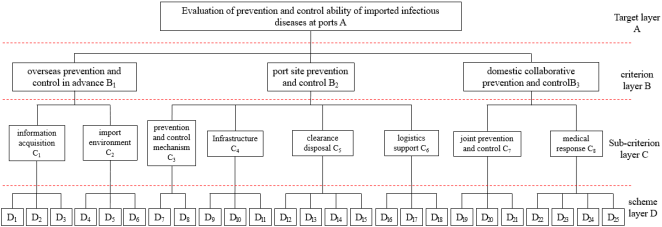
. Based on the interpretation of laws and regulations for the prevention and control of infectious diseases at ports, as well as the collection and analysis of relevant literature, this article organized experts in the field of port health and quarantine to conduct discussions according to the above evaluation principles. Three primary indicators were proposed: overseas prevention and control in advance (B1), port site prevention and control (B2), and domestic collaborative prevention and control (B3). Corresponding secondary indicators were also proposed based on each primary indicator. Among them, the indicator B1 includes two secondary indicators: information acquisition (C1) and import environment (C2). The indicator B2 includes four secondary indicators: prevention and control mechanism (C3), infrastructure (C4), clearance disposal (C5), and logistics support (C6). The indicator B3 includes two secondary indicators: joint prevention and control (C7) and medical response (C8). Based on the main influencing factors of each secondary indicator, 25 scheme level tertiary indicators were proposed. The evaluation index system for the prevention and control capacity of imported infectious diseases at ports is shown in
Figure 1.
In order to use AHP to determine the weight of indicators, the three hierarchical indicators are classified into the criterion layer, sub-criterion layer, and scheme layer in sequence, and the relevant indicators are explained as follows.
Information acquisition (C1). Before the entry of infectious diseases, the port needs to collect relevant information on potential imported infectious diseases, conduct risk prediction, and strengthen monitoring of key pathogens, so as to prepare in advance for high-risk populations, goods, transportation vehicles, etc. C1 can be subdivided into three scheme level indicators. International epidemic situation (D1): The occurrence and prevalence of infectious diseases worldwide, as well as their future development trends, including public health emergencies of international concern and infectious diseases monitored by the General Administration of Customs of China. Epidemic situation at ports for intercourse (D2): Whether monitoring points have been established and whether there have been outbreaks of infectious diseases in the overseas ports for intercourse. Cross border cooperation (D3): Whether a cooperation mechanism has been established with overseas health organizations, and whether good cooperation can be maintained in infectious disease monitoring information sharing, overseas health quarantine, and other aspects with overseas ports for intercourse.
Import environment (C2). The objective conditions for the importation of infectious diseases through ports include the natural environment affecting pathogen transmission, as well as individuals and goods that may carry pathogens. C2 can be further subdivided into three scheme level indicators. Climatic factors (D4): Whether the climatic conditions such as temperature, humidity, precipitation, and wind speed at the port location facilitate the spread of pathogens. Inbound passenger volume (D5): The scale of inbound passengers, where a higher volume increases the number of individuals potentially carrying pathogens. Inbound cargo volume (D6): The total amount of goods entering through the port, as a greater volume of inbound cargo and more cross-border transportation vehicles increase the likelihood of carrying pathogens.
Prevention and control mechanism (C3). The government has established a comprehensive system to prevent and control the spread of imported infectious diseases through ports and ensure the normal operation of ports, including laws and regulations, technical specifications, emergency plans, etc. C3 can be subdivided into two scheme level indicators. Policy and legal provisions (D7): The laws and regulations established by the state at the legislative level for the prevention and control of imported infectious diseases at ports, as well as the rules and regulations conducted at the practical operational level. Emergency response plan (D8): When an emergency situation suddenly occurs, there is an emergency response plan for imported infectious diseases in advance, and the situation could be effectively controlled to minimize losses.
Infrastructure (C4). The infrastructure established by ports to fulfill the function of preventing and controlling imported infectious diseases, including hardware conditions such as venues, equipment, platforms, etc.. C4 can be subdivided into three scheme level indicators. Area setting (D9): The port plans channels and areas for passengers and goods of different risk categories, as well as physical spaces such as screening rooms, isolation areas, quarantine points, etc. prepared to deal with potential abnormal situations. Quarantine inspection equipment (D10): Facial recognition devices, infrared thermal imagers, X-ray machines, and other equipment used at ports to inspect and identify the risk sources of imported infectious diseases. Digital platform (D11): Utilizing information technology such as big data, collecting and analyzing input information on infectious diseases, as well as data related to inbound personnel and goods, to realize a port information management for risk warning and precise control.
Clearance disposal (C5). The port adopts relevant health and quarantine technologies and methods, as well as personnel teams that meet professional requirements, to identify and handle the risk sources of imported infectious diseases. C5 can be subdivided into four scheme level indicators. Professional personnel team (D12): Professional technical personnel engaged in the prevention and control of imported infectious diseases at ports, possessing professional knowledge and skills in quarantine inspection, health supervision, personal protection, etc., and regularly receiving business training. Risk identification screening (D13): The techniques and methods used to identify suspicious objects, including medical surveillance, medical screening, symptom monitoring, epidemiological investigation, sample collection, etc. Rapid detection at ports (D14): The technical capability of ports to conduct on-site rapid identification and appraisal of suspicious objects detected through screening. Risk disposal (D15): The port shall take appropriate control measures and standardized disposal methods for suspected or confirmed imported infectious disease targets to prevent the spread of infectious diseases, including harmless treatment of goods and transportation of risk personnel.
Logistics support (C6). Logistics management auxiliary measures taken by border ports include cleaning and disinfecting the working environment, waste disposal, material reserves, etc. C6 can be subdivided into three scheme level indicators. Public hygiene (D16): It mainly refers to the cleaning and disinfection of public areas at the port, the hygiene guarantee of food and water, and the ventilation and cleaning of areas where personnel and goods gather. Waste disposal (D17): Standardized disposal of solid, liquid and other waste generated from the prevention and control of imported infectious diseases at ports to avoid pollution. Port protective equipment (D18): When conducting frontline work such as infectious disease detection and disposal at ports, sufficient necessary equipment such as masks, goggles, and protective clothing should be provided.
Joint prevention and control (C7). The joint efforts of border ports, local governments, and relevant functional departments to prevent and control imported infectious diseases form a management loop and block the chain of transmission of infectious diseases within the country. C7 can be subdivided into three scheme level indicators. Organizational structure (D19): A joint prevention and control organizational system led by the local government, including customs, centers for disease control and prevention, hospitals, public security and other departments, clarifying the prevention and control process and task division. Local government investment (D20): The degree to which the local government attaches importance to prevention and control work, as well as the level of investment in funds, personnel, venues, and other aspects, in order to prevent imported infectious diseases from entering the location through ports. Communication and collaboration (D21): The actual operational efficiency of local joint prevention and control of imported infectious diseases, including the completeness and timeliness of data sharing, and the degree of coordination and cooperation among relevant responsible departments.
Medical response (C8). The support capacity of local medical and health resources for the prevention and control of imported infectious diseases at ports, as well as the potential for effective containment of infectious disease risks. C8 can be subdivided into four scheme level indicators. Medical service institutions (D22): The adequacy and treatment capabilities of local medical service institutions, including sufficient professional medical personnel, ward beds, diagnostic equipment, isolation facilities, etc. Medical supplies reserve (D23): The adequacy of medical supplies for local treatment and prevention of infectious diseases, including drugs, vaccines, equipment, decontamination products, and other supplies. Laboratory testing (D24): The local high-level laboratory conditions enable analysis and screening of rare pathogens, referral samples, etc., providing laboratory technical support for the identification of infectious diseases at ports. Public awareness (D25): The level of local promotion and education on infectious disease prevention and control, the public's knowledge of hygiene and disease prevention, and the awareness of individual proactive protection.
3.3. Method for Determining Indicator Weights
According to the evaluation index system for the prevention and control capability of imported infectious diseases at ports, AHP is used to further determine the weights of the index system. Experts engaged in border port health quarantine work and port public health research were invited to score the evaluation indicators. Experts will compare the indicators at the same level pairwise, and the scoring rules will use a 9-point scale, as shown in
Table 1. The weight vector of the evaluation index will be calculated by judging the eigenvectors of the matrix, and the maximum eigenvalue will be used for consistency testing. The steps are as follows.
Table 1.
Scale and meaning of judgment matrix. Scale and meaning of judgment matrix. Scale and meaning of judgment matrix. Scale | Meaning |
1 | Element i is equally important as element j |
3 | Element i is slightly more important than element j |
5 | Element i is significantly more important than element j |
7 | Element i is more strongly important than element j |
9 | Element i is extremely more important than element j |
2, 4, 6, 8 | The median of the adjacent scales mentioned above |
Countdown | If the ratio of the importance of element i to element j is aij,then the ratio of the importance of element j to element i is aji=1/aij |
3.3.1. Constructing Judgment Matrices
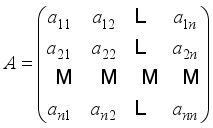
Geometric mean processing will be performed on the expert rating results to construct a judgment matrix, as shown in equation (
1). Among them, a
ij is the geometric mean of the comparison results between indicators i and j at the same level, and n is the number of indicators. Based on this, judgment matrices for the criterion layer, sub-criterion layer, and scheme layer can be constructed separately.
 (1)
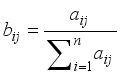
(1) Using the summation method to calculate weight vectors W=(w1, w2, … wn)T,
 (2)
(2) 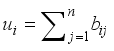 (3)
(3) 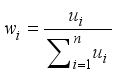 (4)
(4) In the above equations, bij is the corresponding element in the new matrix B obtained by normalizing each column of the judgment matrix A, ui is the accumulated value of all elements in the i row of the new matrix B, and wi is the normalized corresponding value of element ui, which is the corresponding weight value of evaluation indicator i.
3.3.2. Consistency Check
By calculating the consistency ratio (CR), further consistency testing is performed on the judgment matrix to determine the logical rationality of expert evaluation. The maximum eigenvalue
λmax of the judgment matrix can be calculated using formula (
5). The Consistency Index (CI) represents the consistency index of the judgment matrix, and the calculation formula is shown in equation (
6).
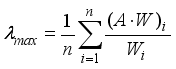 (5)
(5) 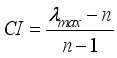 (6)
(6) RI is a random consistency indicator, as shown in
Table 2.
Table 2.
Random consistency index. Random consistency index. Random consistency index. Matrix order | 1 | 2 | 3 | 4 | 5 | 6 | 7 | 8 |
RI | 0 | 0 | 0.52 | 0.89 | 1.12 | 1.26 | 1.36 | 1.41 |
When CR<0.1, the judgment matrix passes the consistency check, otherwise it needs to be readjusted until the judgment matrix meets the consistency requirements.
3.4. Fuzzy Comprehensive Evaluation Method
3.4.1. Factor set and Comment Set
The factor set U is a collection of relevant factors that have an impact on the evaluation object. The evaluation index system mentioned above constitutes the factor set for evaluating the prevention and control capabilities of imported infectious diseases at ports, which is specifically divided into four layers, U={ui} (i=1, 2, 3, 4). The first target layer is the evaluation of the ability to prevent and control imported infectious diseases at the port u1, the second criterion layer u2 consists of 3 factors, the third criterion layer u3 consists of 8 factors, and the fourth scheme layer u4 consists of 25 factors. The comment set V={v1, v2, …, vm} is the collection of all evaluation results given by the evaluation subject to the evaluation object. According to the implementation of prevention and control of imported infectious diseases at Chinese border ports, the evaluation results are divided into 5 levels. The evaluation set is defined as V={very good, good, average, poor, very poor}, with corresponding scores of {100, 80, 60, 40, 20}, thus comprehensively demonstrating the level of cross-border transmission prevention and control of infectious diseases.
3.4.2. Fuzzy Comprehensive Evaluation
On the basis of determining the factor set and comment set, the membership degree of the evaluation indicator
ui can be further calculated and quantified by distributing questionnaires. The fuzzy evaluation matrix is
R=(
rij)
n×m, where
rij is the membership value of the evaluation index corresponding to the comment set. Multiplying the weight vector
W of the evaluation indicators for the prevention and control capability of imported infectious diseases at the port with the fuzzy evaluation matrix
R yields the evaluation result vector
G of the corresponding hierarchical evaluation indicators, as shown in equation (
8).
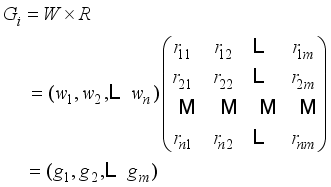 (8)
(8) According to the principle of maximum membership degree, the evaluation grade of the target can be determined. Through the comment score and the corresponding weight, the score of the target can be further calculated. In this paper, the fuzzy comprehensive evaluation will start from the lowest level of the scheme layer factors, step by step upward evaluation, until the calculation of the evaluation vector of the target layer, to evaluate the prevention and control ability of imported infectious diseases at border ports in China.
4. Empirical Analysis
4.1. Calculation of Indicator Weights
According to the calculation steps of indicator weights explained earlier, experts in the field of infectious disease prevention and control at ports were invited to compare the indicators at the target layer, criterion layer, and sub-criterion layer pairwise, assign values, and perform geometric mean processing on the data to calculate the element values of the judgment matrix. The evaluation values of the five experts are shown in
Table 3.
Table 3.
Expert evaluation. Expert evaluation. Expert evaluation. Indicator | Overseas prevention and control in advance B1 | port site prevention and control B2 | domestic collaborative prevention and control B3 |
Overseas prevention and control in advance B1 | 1 | \ | \ |
port site prevention and control B2 | 5; 3; 8; 2; 1 | 1 | \ |
domestic collaborative prevention and control B3 | 3; 5; 5; 1; 1 | 0.5; 0.2; 0.5; 1; 1 | 1 |
According to equation (
5), the maximum eigenvalue is calculated,

.

,
CR=CI/RI=0.0144,
Since the CR is less than 0.1, it is considered that the judgment matrix has passed the consistency test, and the weight vectors of the target layer indicators are calculated as (0.1549, 0.5209, 0.3242).
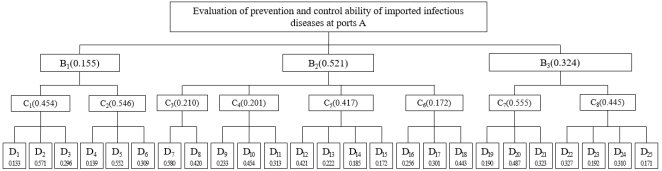
Similarly, through consistency testing, the indicator weights of the criterion layer and the sub-criterion layer can be solved separately. The weights of the indicator system are shown in
Figure 2.
4.2. Analysis of Indicator Weight Results
From the perspective of criterion level indicators, the weight of indicator B2 is 52.09%, accounting for more than half of the total, and is the most core indicator for evaluating the ability of ports to prevent and control imported infectious diseases. Border ports are key places for preventing and controlling the spread of imported infectious diseases within the country, and the government has invested a large number of personnel, equipment, and platforms at the ports. A specialized health and quarantine system has become an important guarantee for safeguarding the biological safety of national borders. The weights of indicators B3 and B1 are 32.42% and 15.49% respectively, indicating that the reuse of domestic linkage prevention and control is more prominent. The local government attaches great importance to the prevention and control of imported infectious diseases, which can form an important supplement to the prevention and control work at ports, thereby limiting the risk of imported infectious diseases within a controllable range and avoiding large-scale outbreaks. Pre prevention and control measures taken overseas have a positive effect on the normalization of monitoring and early warning of imported infectious diseases, which can provide more favorable conditions for ports to prevent and control key infectious diseases in advance.
From the perspective of sub-criteria indicators, the two indicators of clearance disposal (C5) and joint prevention and control (C7) have a relatively high weight, accounting for over 15% of the total. This indicates that the prevention and control of imported infectious diseases should be addressed through the inspection, identification, and standardized disposal of infectious diseases at ports, as well as effective collaborative measures taken by local governments. Secondly, the three indicators of prevention and control mechanism (C3), infrastructure (C4), and medical response (C8) have similar weights, accounting for over 10% of the total. Comprehensive policies and regulations can provide institutional guarantees for the prevention and control of imported infectious diseases at ports, advanced infrastructure can provide reliable hardware support, and strong local medical and health resources can effectively control the risk of infectious disease spread. Therefore, these indicators are relatively important. The three indicators of information acquisition (C1), import environment (C2), and logistics support (C6) account for a relatively low proportion. Due to the fact that the physical links of infectious disease prevention and control are at ports and domestic medical facilities, and more emphasis is placed on innovation in program design, inspection methods, medical technology, etc., the requirements for routine matters are not high. Therefore, these three indicators have a relatively small direct impact on the prevention and control of imported infectious diseases at ports compared to other indicators.
From the perspective of scheme level indicators, the comprehensive weight of the professional personnel team (D12) is the highest, reaching 9.15%, indicating that high-quality health and quarantine professionals have played a significant role in infectious disease identification, sanitation treatment, port construction, and are crucial for preventing and controlling imported infectious diseases. The weights of indicators such as local government investment (D20), policy and legal provisions (D7), and communication and collaboration (D21) all exceed 5%, indicating that scientific health and quarantine legal basis, sufficient resources invested by local governments in infectious disease prevention and control, and close cooperation between relevant responsible departments can significantly improve the ability to prevent and control infectious diseases. In contrast, indicators reflecting objective factors from overseas and indicators reflecting domestic public environment have smaller weights. The weights of six indicators, namely international epidemic situation (D1), cross border cooperation (D3), climate factors (D4), area setting (D9), public hygiene (D16), and public awareness (D25), are all less than 2.5%, with international epidemic situation (D1) having the lowest proportion. The above results analysis is basically consistent with the policy orientation and practical work of imported infectious disease prevention and control at ports, and meets the relevant requirements for enhancing the core capacity of public health at ports.
4.3. Analysis of Fuzzy Comprehensive Evaluation Results
This article takes J Port in Jiangsu Province, China as the empirical research object and conducts a fuzzy evaluation of its ability to prevent and control imported infectious diseases. The evaluation level set V={
v1,
v2,
v3,
v4,
v5}={very good, good, average, poor, very poor}. 15 experts in the field of imported infectious disease prevention and control at J port were invited to conduct a fuzzy evaluation of the 25 indicators at the scheme level based on their professional theoretical knowledge and daily work. The evaluation results of the evaluation indicators are shown in
Table 4.Table 4.
Results of Evaluation Indicators. Results of Evaluation Indicators. Results of Evaluation Indicators. Indicator | v1 | v2 | v3 | v4 | v5 |
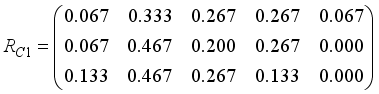
D1 | 0.067 | 0.333 | 0.267 | 0.267 | 0.067 |
D2 | 0.067 | 0.467 | 0.200 | 0.267 | 0.000 |
D3 | 0.133 | 0.467 | 0.267 | 0.133 | 0.000 |
D4 | 0.133 | 0.267 | 0.267 | 0.333 | 0.000 |
D5 | 0.133 | 0.200 | 0.333 | 0.333 | 0.000 |
D6 | 0.133 | 0.267 | 0.533 | 0.067 | 0.000 |
D7 | 0.333 | 0.600 | 0.067 | 0.000 | 0.000 |
D8 | 0.267 | 0.600 | 0.067 | 0.067 | 0.000 |
D9 | 0.200 | 0.467 | 0.133 | 0.133 | 0.067 |
D10 | 0.067 | 0.533 | 0.333 | 0.067 | 0.000 |
D11 | 0.200 | 0.400 | 0.200 | 0.133 | 0.067 |
D12 | 0.133 | 0.533 | 0.133 | 0.133 | 0.067 |
D13 | 0.067 | 0.600 | 0.267 | 0.067 | 0.000 |
D14 | 0.133 | 0.467 | 0.333 | 0.067 | 0.000 |
D15 | 0.133 | 0.733 | 0.133 | 0.000 | 0.000 |
D16 | 0.200 | 0.733 | 0.067 | 0.000 | 0.000 |
D17 | 0.267 | 0.667 | 0.067 | 0.000 | 0.000 |
D18 | 0.533 | 0.467 | 0.000 | 0.000 | 0.000 |
D19 | 0.600 | 0.333 | 0.067 | 0.000 | 0.000 |
D20 | 0.267 | 0.267 | 0.333 | 0.133 | 0.000 |
D21 | 0.400 | 0.467 | 0.067 | 0.067 | 0.000 |
D22 | 0.267 | 0.667 | 0.067 | 0.000 | 0.000 |
D23 | 0.400 | 0.467 | 0.133 | 0.000 | 0.000 |
D24 | 0.267 | 0.400 | 0.267 | 0.067 | 0.000 |
D25 | 0.067 | 0.533 | 0.267 | 0.133 | 0.000 |
From the above table, it can be found that the evaluation opinions of the four indicators D1, D9, D11 and D12 are relatively scattered, and five different fuzzy evaluation levels are included. The evaluation opinion of indicator 18 is the most concentrated, including only two evaluation grades.
Based on the evaluation results of the scheme layer indicators, a fuzzy evaluation matrix for the sub-criterion layer can be obtained. The fuzzy evaluation matrix Rc1 of indicator C1 is:
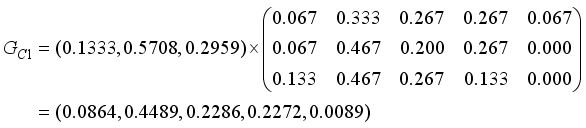
According to the multi-level fuzzy comprehensive evaluation theory, equation (
8) was used to calculate the fuzzy evaluation vector of the sub-criterion layer indicator C1:
Similarly, the fuzzy evaluation vectors of the remaining 7 indicators in the sub-criterion layer can be calculated sequentially.
GC2=(0.1333, 0.2299, 0.3859, 0.2509, 0)
GC3=(0.3053, 0.6000, 0.0667, 0.0280, 0)
GC4=(0.1395, 0.4761, 0.2450, 0.1031, 0.0364)
GC5=(0.1185, 0.5702, 0.1999, 0.0833, 0.0281)
GC6=(0.3677, 0.5952, 0.0372, 0, 0)
GC7=(0.3730, 0.3439, 0.1966, 0.0865, 0)
GC8=(0.2579, 0.5229, 0.1757, 0.0435, 0)
According to the principle of maximum membership degree, the six indicators of C1, C3, C4, C5, C6, and C8, have the highest degree of membership in the "good" category, so these indicators are judged to be at the "good" level. The indicator C2 has the highest degree of membership in the "general" level, therefore it is considered that the input environment indicator is at the "general" level. In addition, the indicator C7 has the highest degree of membership in the "very good" level, so it is judged that the joint defense control is at the "very good" level.
According to the fuzzy evaluation vector of the sub-criterion layer, the fuzzy evaluation matrix of the corresponding criterion layer indicators can be obtained, where the fuzzy evaluation matrix RB1 of indicator B1 is:

,
Thus, the fuzzy evaluation vector of indicator B1 can be further calculated.
Similarly, the fuzzy evaluation vectors of the other two indicators in the criterion layer can be calculated.
GB2=(0.2048, 0.5619, 0.1530, 0.0613, 0.0190)
GB3=(0.3218, 0.4236, 0.1873, 0.0674, 0)
It is not difficult to find that both the indicator B2 and B1are at a "good" level. The indicator B1 is at a "good" level, but its membership degree between "good" and "general" levels is very close, indicating that the overseas pre prevention and control measures actively taken by J port are slightly insufficient.
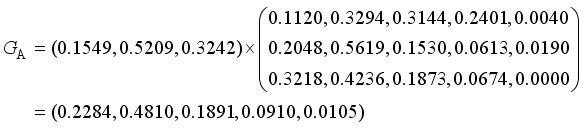
Next, based on the fuzzy evaluation matrix of the criterion layer, the fuzzy evaluation vector of imported infectious disease prevention and control capability of J port can be calculated.
Matching the scores of each element in the evaluation set with their corresponding membership degrees can further quantify the evaluation result F.
F=[0.2284, 0.4810, 0.1891, 0.0910, 0.0105]*[100, 80, 60, 40, 20]T=76.51
Based on the above results, it can be found that the imported infectious disease prevention and control capability of J port belongs to the highest membership degree of "good" level, which is 0.481. Therefore, the fuzzy comprehensive evaluation result is "good". The quantitative results further show that the imported infectious disease prevention and control capability score of J Port is 76.51, which is between "good" and "average". It can be considered that the imported infectious disease prevention and control capability of J Port is at a level of "good" to "average". Therefore, there is still room for improvement in the prevention and control capabilities of imported infectious diseases at J Port.
5. Research Conclusions and Suggestions
5.1. Research Conclusions
Preventing and controlling the spread of imported infectious diseases through ports into the country is an important component of building a national public health system, playing a crucial role in maintaining social security and stability, and safeguarding people's physical health. Faced with the increasingly severe situation of infectious disease prevention and control, grasping the key points of imported infectious disease prevention and control at ports, and accurately identifying weak links have become important theoretical and practical issues. Based on this, this article combines existing theoretical research and China's port imported infectious disease prevention and control policy system, and uses AHP to construct an evaluation index system for imported infectious disease prevention and control capabilities of border ports, which includes 3 criterion level indicators, 8 sub-criterion level indicators, and 25 scheme level indicators, solving the uncertainty problem between qualitative indicators. Meanwhile, taking J Port in Jiangsu Province, China as an example, the fuzzy comprehensive evaluation method was used to empirically evaluate its ability to prevent and control imported infectious diseases, verifying the rationality and operability of the indicator system. The results show that the professional personnel team has the greatest impact on the prevention and control capabilities of infectious diseases at ports, while the influence of local government investment, policies and laws, and communication and collaboration is more important. The overall prevention and control capability of imported infectious diseases at J Port is at a "good" to "average" level. This article can provide reference for optimizing the prevention and control path of imported infectious diseases and enhancing the core capacity of public health at ports.
5.2. Suggestions
Firstly, strengthen the construction of professional talent team. Professional talents are the most important factor in preventing and controlling imported infectious diseases. Specific work in infectious disease prevention and control, such as medical examinations, epidemiological investigations, medical assistance, and emergency response, cannot be separated from professional talents. A high-quality health and quarantine team can provide comprehensive talent support and intellectual support for improving the prevention and control capabilities of imported infectious diseases at ports. Therefore, it is necessary to improve the quality of talent introduction at the source and strengthen the effective connection between the talent training system in universities and the practice of port health and quarantine. Strengthening professional knowledge and skills training, improving incentive mechanisms for career development, and actively engaging in international cooperation can all help improve the comprehensive quality of the existing talent team in customs.
Secondly, accelerate technological innovation in health and quarantine. The construction of smart customs is an important measure for Chinese ports to enhance their ability to prevent and control infectious diseases. Technological innovation can significantly improve the accuracy and timeliness of the prevention and control of imported infectious diseases at ports. Therefore, ports need to actively integrate information technology such as artificial intelligence and big data into the application scenarios of infectious disease prevention and control, vigorously develop and promote the use of intelligent detection equipment and digital platforms, and continuously improve the monitoring, identification, and early warning capabilities of imported infectious diseases using new technologies. In addition, the customs need to provide policy guidance, encourage frontline personnel to participate in academic research, patent applications, scientific research projects, etc., and actively create a strong scientific research atmosphere, so as to enhance the innovative potential of infectious disease prevention and control work.
Thirdly, deepen cooperation in epidemic prevention and control among relevant regions. Preventing and controlling the spread of imported infectious diseases within the territory is the joint responsibility of customs and local governments. Through multi-party cooperation, all parties can leverage their respective advantages to jointly ensure the public health and safety of the territory. Therefore, customs and relevant local responsible departments need to carefully formulate and strictly implement joint prevention and control plans for imported infectious diseases, regularly communicate and judge the development situation of infectious diseases, timely share infectious disease risk information, and build a clear division of labor and closely coordinated work chain. The local government needs to increase its support for customs on infectious disease prevention and control, further improve policies and regulations, timely allocate necessary medical supplies and emergency personnel, strengthen the construction of medical institutions and laboratories, and provide strong local comprehensive support.
Abbreviations
AHP | Analytic Hierarchy Process |
WHO | World Health Organization |
COVID-19 | Coronavirus Disease 2019 |
CR | Consistency Ratio |
Author Contributions
Lu Cai: Formal Analysis, Software, Writing – original draft
Kangni Xu: Data curation, Validation, Writing – review & editing
Rong Xu: Project administration, Writing – review & editing
Guotao Chen: Methodology, Supervision, Writing – review & editing
Feng Yao: Investigation, Resources, Writing – review & editing
Jia Li: Supervision, Writing – review & editing
Yunhui Dai: Conceptualization, Funding acquisition, Writing – review & editing
Funding
This work is supported by the Nanjing Customs Scientific Research Project (Grant No. 2024KJ15) and the China Postdoctoral Science Foundation (Certificate No. 2024M751200).
Conflicts of Interest
The authors declare no conflicts of interest.
References
| [1] |
Ye Y, Li L, Zhu L, et al. Measures and considerations for responding to major pandemic at frontier ports [J]. Chin. J of PHM. Dec, 2023, 39(06): 774-777.
https://doi.org/10.19568/j.cnki.23-1318.2023.06.0005
|
| [2] |
Zhang Q, Bai G, Wang Q, et al. Construction of an evaluation index system for effectiveness of plague prevention and control in otog banner demonstration area, inner mongolia autonomous region: A Delphi expert consultation study [J]. Chin J Public Health, 2024, 40(07): 868-873.
https://doi.org/10.11847/zgggws1143150
|
| [3] |
General Administration of Customs of the People's Republic of China. Monthly report on risk monitoring of infectious diseases at ports in 2025 (October) [EB/OL]. (2025-11-14) (2025-11-19).
http://wss.customs.gov.cn/wss/yqjc/6824919/index.html
|
| [4] |
Jiang N, Mao SH, Wen JH, et al. Practice of port epidemic risk prevention and control management based on risk assessment and process reengineering [J]. Chin Health Resour, 2022, 25(06): 785-789+798.
https://doi.org/10.13688/j.cnki.chr.2022.220675
|
| [5] |
Liao DZ, Lyu, TY, Li J. United by Contagion: How Can China Improve Its Capabilities of Port Infectious Disease Prevention and Control? [J]. HEALTHCARE, 2022, 10(8): 1359.
https://doi.org/10.3390/healthcare10081359
|
| [6] |
Sun RS, Zeng C, Sun JY. Multi-hazards risk aggregation of sudden infectious disease epidemic in airport terminals [J]. J. Saf. Environ, 2022, 22(01): 347-352.
https://doi.org/10.13637/j.issn.1009-6094.2020.1369
|
| [7] |
Wen Z, Xiang YY, Zhou LC, et al. Risk assessment for imported infectious diseases at ports of "the Belt and Road" countries along the route [J]. Chin. Front. Health Quar, 2022, 45(03): 210-215.
https://doi.org/10.16408/j.1004-9770.2022.03.010
|
| [8] |
Zhang Y, Wang YH, Lin SH, et al. Stablishment of the global infectious disease surveillance and early warning information system based on multi-data fusion and its preliminary application [J]. Chin J Nosocomiol, 2025, 35(24): 3768-3774.
https://doi.org/10.11816/cn.ni.2025-251965
|
| [9] |
Han H, Wu B, Jia JJ, et al. Risk Assessment of global monkeypox in september 2023 [J]. Port Health Control., 2023, 28(06): 52-55.
https://doi.org/10.3969/j.issn.1008-5777.2023.06.012
|
| [10] |
Jin Q. The Process of Establishing His Corean Majesty's Customs Service Quarantine System and the Response to the Influx of Infectious Diseases from 1886 to 1893 [J]. Korean J Med Hist, 2020, 29(3): 1029-1064.
https://doi.org/10.13081/kjmh.2020.29.1029
|
| [11] |
Li WW, Hu ZL. Review and optimization of rules for port states' public health risk assess [J]. Chin. J. Mar. L., 2023, 34(03): 35-48.
|
| [12] |
Lu MY, Yang QY, Yan B, et al. Research on the assessment standards for the core capabilities building in public health at domestic ports based on “state party self-assessment annual reporting tool” [J]. Chin. Front. Health Quar, 2024, 47(02): 148-151.
https://doi.org/10.16408/j.1004-9770.2024.02.009
|
| [13] |
Cheng X, Huang LQ, Chen D, et al. Establishment of a multi-source data comprehensive index system for early warning of respiratory infectious diseases in port cities in China [J]. Chin J Public Health, 2022, 38(09): 1160-1163.
https://doi.org/10.11847/zgggws1137870
|
| [14] |
Sun XD, Zhang Y, Liu Y, et al. Rapid risk assessment for COVID-19 importation December 2021 [J]. Chin. Front. Health Quar, 2022, 45(01): 16-18.
https://doi.org/10.16408/j.1004-9770.2022.01.006
|
| [15] |
Han YX, Wu B, Chen ZX, et al. Risk assessment of global cholera epidemic in 2023 [J]. Dis. Surveill. 2024, 39(03): 268-272.
https://doi.org/10.3784/jbjc.202300230617
|
| [16] |
Ren MX, Xiong QM, Zhou JY, et al. Comprehensive assessment of the risk of dengue fever importation and local transmission in Guangxi from ASEAN countries [J]. Modern Preventive Medicine, 2025, 52(9): 1700-1704+1723.
https://doi.org/10.20043/j.cnki.MPM.202501214
|
| [17] |
Li YM, Wu BW, Liu SY, et al. Risks and the prevention and control deployment of COVID-19 infection along the border of Ruili city based on the AHP entropy weight method [J]. Remote Sens. Nat. Resour. 2022, 34(03): 218-226.
https://doi.org/10.6046/zrzyyg.2021299
|
| [18] |
Li L, Ju CF, Wen XJ, et al. Research on the application of crisis management theory in the construction of epidemic prevention and control team of customs at ports [J]. Port Health Control., 2022, 27(04): 6-9.
https://doi.org/10.3969/j.issn.1008-5777.2022.04.002
|
| [19] |
Liu WS, Hu WS, Dong ZQ, et al. Epidemiological characteristics of imported infectious diseases in Guangzhou,2005-2019 [J]. Mod. Prev. Med, 2020, 47(09): 1555-1557+1574.
|
| [20] |
The Central Government of the People's Republic of China. Guarding the country's borders, stabilizing foreign trade, and serving the overall economic and social development [EB/OL]. (2023-03-21) (2025-11-19).
https://www.gov.cn/xinwen/2023-03/21/content_5747625.htm
|
| [21] |
National Immigration Administration of the People's Republic of China. Make every effort to strengthen the "three lines of defense" against the importation of overseas epidemics [EB/OL]. (2020-03-23) (2025-11-19).
https://www.nia.gov.cn/n741435/n1194535/n1273412/index.html
|
| [22] |
Xu JG, Shu YL, Yi ZJ, et al. Modernization of national border biosecurity defense system [J]. Strategic Study of CAE, 2023, 25(05): 21-29.
https://doi.org/10.15302/J-SSCAE-2023.05.001
|
Cite This Article
-
APA Style
Cai, L., Xu, K., Xu, R., Chen, G., Yao, F., et al. (2025). Research on the Prevention and Control Capacity of Imported Infectious Diseases at Chinese Ports Based on Fuzzy Comprehensive Evaluation. Journal of Public Policy and Administration, 9(4), 276-288. https://doi.org/10.11648/j.jppa.20250904.17
 Copy
|
Copy
|
 Download
ACS Style
Cai, L.; Xu, K.; Xu, R.; Chen, G.; Yao, F., et al. Research on the Prevention and Control Capacity of Imported Infectious Diseases at Chinese Ports Based on Fuzzy Comprehensive Evaluation. J. Public Policy Adm. 2025, 9(4), 276-288. doi: 10.11648/j.jppa.20250904.17
Copy
|
Download
AMA Style
Cai L, Xu K, Xu R, Chen G, Yao F, et al. Research on the Prevention and Control Capacity of Imported Infectious Diseases at Chinese Ports Based on Fuzzy Comprehensive Evaluation. J Public Policy Adm. 2025;9(4):276-288. doi: 10.11648/j.jppa.20250904.17
Copy
|
Download
-
@article{10.11648/j.jppa.20250904.17,
  author = {Lu Cai and Kangni Xu and Rong Xu and Guotao Chen and Feng Yao and Jia Li and Yunhui Dai},
  title = {Research on the Prevention and Control Capacity of Imported Infectious Diseases at Chinese Ports Based on Fuzzy Comprehensive Evaluation},
  journal = {Journal of Public Policy and Administration},
  volume = {9},
  number = {4},
  pages = {276-288},
  doi = {10.11648/j.jppa.20250904.17},
  url = {https://doi.org/10.11648/j.jppa.20250904.17},
  eprint = {https://article.sciencepublishinggroup.com/pdf/10.11648.j.jppa.20250904.17},
  abstract = {This paper took the prevention and control of imported infectious diseases spreading from ports to the domestic territory as the research scenario, and employed fuzzy comprehensive evaluation to analyze port infectious disease prevention and control capabilities. Based on the characteristics of port infectious disease prevention and control and relevant policy requirements, an evaluation system was constructed, comprising three primary indicators—overseas prevention and control in advance, port site prevention and control, and domestic collaborative prevention and control, along with eight secondary indicators and 25 tertiary indicators. The prevention and control ability of imported infectious diseases at ports was quantitatively evaluated by using analytic hierarchy process and fuzzy evaluation method. Taking Port J of Jiangsu Province in China as the empirical research subject, the rationality and operability of the evaluation method were verified. The findings indicated that factors such as professional personnel teams, local government investment, policies and laws, and communication and collaboration have significant impacts. The fuzzy evaluation of J Port has the highest membership degree in the "good" level, with an overall score of 76.51. The ability to prevent and control imported infectious diseases of J Port is at a level of "good" to "average". Based on these findings, relevant policy recommendations were proposed.},
 year = {2025}
}
Copy
|
Download
-
TY  - JOUR
T1  - Research on the Prevention and Control Capacity of Imported Infectious Diseases at Chinese Ports Based on Fuzzy Comprehensive Evaluation
AU  - Lu Cai
AU  - Kangni Xu
AU  - Rong Xu
AU  - Guotao Chen
AU  - Feng Yao
AU  - Jia Li
AU  - Yunhui Dai
Y1  - 2025/12/29
PY  - 2025
N1  - https://doi.org/10.11648/j.jppa.20250904.17
DO  - 10.11648/j.jppa.20250904.17
T2  - Journal of Public Policy and Administration
JF  - Journal of Public Policy and Administration
JO  - Journal of Public Policy and Administration
SP  - 276
EP  - 288
PB  - Science Publishing Group
SN  - 2640-2696
UR  - https://doi.org/10.11648/j.jppa.20250904.17
AB  - This paper took the prevention and control of imported infectious diseases spreading from ports to the domestic territory as the research scenario, and employed fuzzy comprehensive evaluation to analyze port infectious disease prevention and control capabilities. Based on the characteristics of port infectious disease prevention and control and relevant policy requirements, an evaluation system was constructed, comprising three primary indicators—overseas prevention and control in advance, port site prevention and control, and domestic collaborative prevention and control, along with eight secondary indicators and 25 tertiary indicators. The prevention and control ability of imported infectious diseases at ports was quantitatively evaluated by using analytic hierarchy process and fuzzy evaluation method. Taking Port J of Jiangsu Province in China as the empirical research subject, the rationality and operability of the evaluation method were verified. The findings indicated that factors such as professional personnel teams, local government investment, policies and laws, and communication and collaboration have significant impacts. The fuzzy evaluation of J Port has the highest membership degree in the "good" level, with an overall score of 76.51. The ability to prevent and control imported infectious diseases of J Port is at a level of "good" to "average". Based on these findings, relevant policy recommendations were proposed.
VL  - 9
IS  - 4
ER  -
Copy
|
Download






 Share This Article
 Twitter
 Linked In
 Facebook